
Sometimes life feels like you are inside a story you were never given the script for.
You learn quickly that there are expectations. Not always spoken, but always present. Ways of behaving, ways of responding, ways of becoming. You begin to notice that certain versions of yourself are welcomed, and others are not. And so, without fully realising it, you start to shape yourself in advance. You anticipate. You adjust. You cut.
At first, this is called learning.
Then it becomes survival.

Over time, something more subtle happens. The part of you that moved freely — that followed curiosity, connection, intrinsic motivation — begins to negotiate with the world rather than meet it. You do not stop being yourself entirely. You adapt just enough to remain intact while still being acceptable. You carry both.
And when strain appears — when anxiety rises, when behaviour shifts, when something doesn’t quite hold — it is often described as a problem within you. A failure to regulate. A lack of motivation. A deficit to be corrected.
But what if that strain is not failure?
What if it is evidence of adaptation?

What if what we call dysfunction is often the body and mind doing exactly what is required to survive the systems we have built?
This is the first fracture: the moment where lived experience and the explanations given to us no longer align.
Most people feel this, but cannot yet name it.
There is, however, a simple way to see it.
Every system you have ever encountered — a family, a workplace, a school, a court, a government — is not something abstract or distant. It is not just rules, policies, or structures.
A system is what emerges when relationship is given order.
Relationship + Order = System

Relationship is primary. It is the first condition of human life. We are born into it, shaped by it, sustained through it. Order comes after. It organises, stabilises, and repeats patterns of relationship over time.
When order is aligned with relationship — when it protects dignity, reciprocity, and freedom — systems become enabling. They hold people. They allow growth. They create space for complexity without collapse.
But when order begins to dominate relationship, something shifts.
The system still functions. In fact, it may appear to function better. It becomes more efficient, more measurable, more defensible. It produces outputs. It demonstrates compliance. It can explain itself clearly.
But beneath that clarity, relationship begins to thin.
Connection is replaced by procedure. Understanding is replaced by categorisation. Engagement is replaced by attendance. People are no longer met in their fullness, but processed through the requirements of the system.
And slowly, almost invisibly, the system begins to ask something different of those within it.
It asks them to adapt to the order, rather than shaping the order around the relationship.
This is the second fracture.

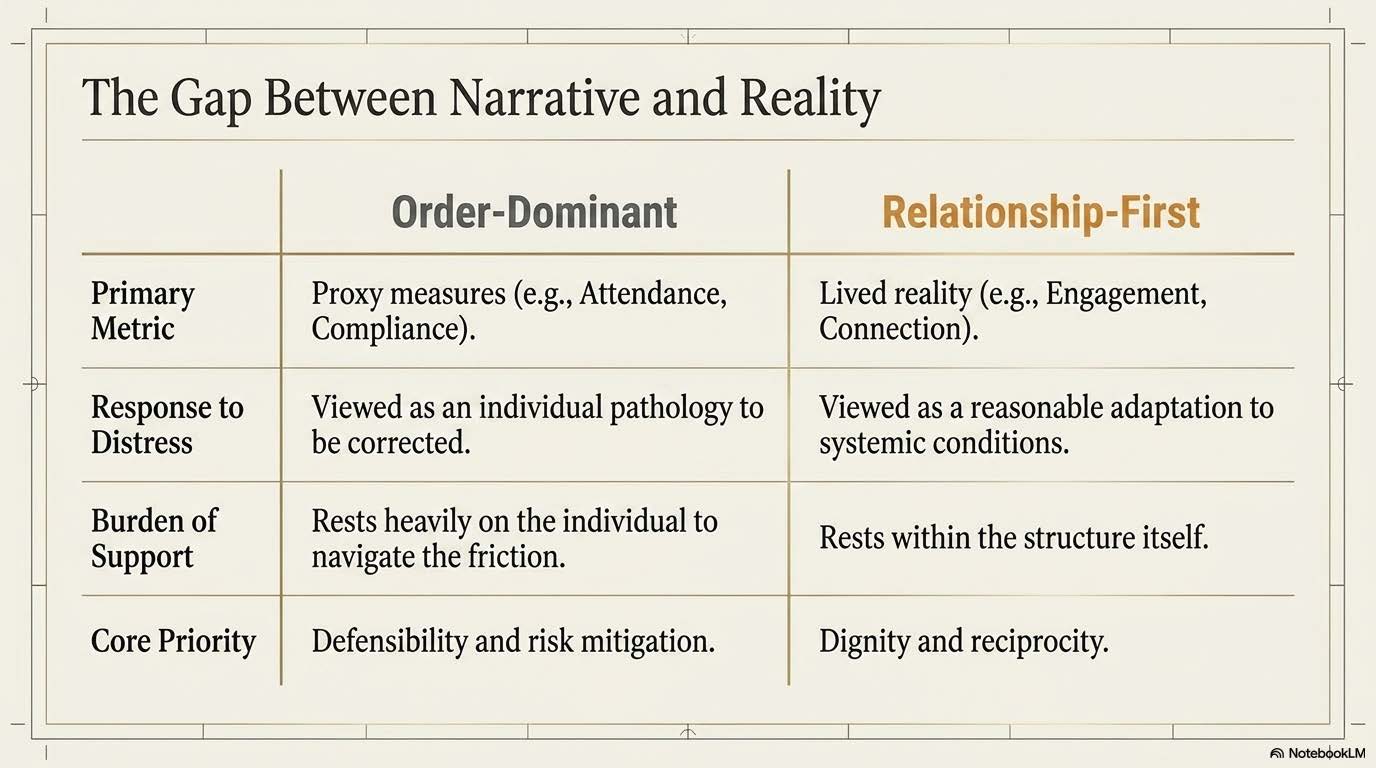
When order overtakes relationship, the burden of maintaining the system shifts.
It moves from the structure onto the individual.
Missed appointments become personal failure, even when the system is inconsistent. Distress becomes pathology, even when it is a reasonable response to instability. Behaviour becomes the focus, detached from the conditions that produced it.
Proxy measures begin to stand in for reality. Attendance replaces engagement. compliance replaces understanding. risk replaces relationship.

The system tells a clean story about itself.
But the lived experience is far more complex.
And the gap between those two narratives is carried somewhere.
It is carried by people.
People begin to hold what does not belong to them. They carry the weight of systemic friction as if it were personal inadequacy. They internalise patterns that were never solely theirs to hold. They learn to explain themselves in the language of the system, even when that language cannot fully account for their experience.
This is how harm becomes individualised.
This is how systems that are misaligned with relationship continue to sustain themselves.
Not because they are entirely wrong, but because they are partially right — and deeply incomplete.
At this point, disagreement emerges.
Some people defend the system. They see its necessity, its structure, its history. They believe that without it, things would fall apart.
Others begin to sense its limits. They notice the gaps, the inconsistencies, the quiet forms of harm that are not easily measured.
Still others begin to imagine something different. Not the absence of order, but a different relationship to it.
These positions are often experienced as conflict. But they are not simply differences in opinion.
They are differences in position.
They are differences in where people sit in their understanding of the system itself.
We are not all seeing the same thing at the same time.
We are moving through different stages of recognition.
The question, then, is not whether we need systems.
We do.
The question is how those systems are built.

If systems are relationship structured by order, then the direction matters.
When order is placed above relationship, systems will eventually consume the very connections they rely on. They will require increasing levels of adaptation from individuals to maintain stability. They will become more rigid, more defensive, and more distant from lived reality.
But when relationship is placed first — when order is designed to serve and protect it — systems begin to behave differently.
They become responsive rather than reactive. They hold complexity rather than compress it. They recognise that people are not variables to be managed, but participants in an ongoing relational process.
This is not the removal of order.
It is its reorientation.
For this to be more than an idea, it requires a boundary.
There must be a point below which no system is allowed to fall.
This is the ethical floor.
A set of conditions that are not negotiable, regardless of efficiency, regardless of pressure, regardless of context.
The right to dignity.The right to be understood in context.
The right not to carry what belongs to the system.
The right to participate in shaping the structures that shape you.
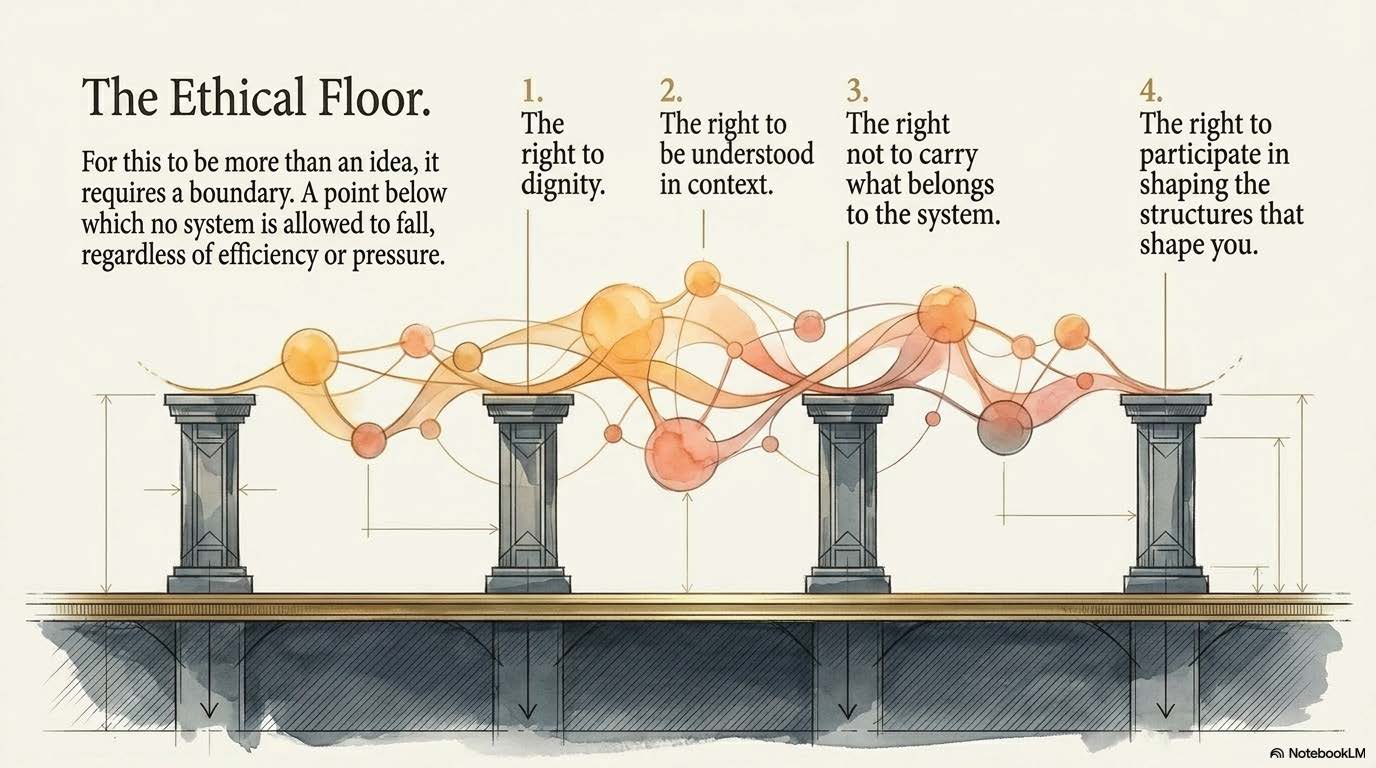
Without this floor, any system can justify itself.
With it, systems are held to account not just for what they produce, but for how they hold relationship.
From here, a different kind of design becomes possible.
Not programs that impose change, but systems that support it.
Not rigid pathways, but sequences that respond to where a person actually is.
Stability before expectation.Regulation before cognition.
Understanding before correction.
Identity before compliance.
Integration before independence.

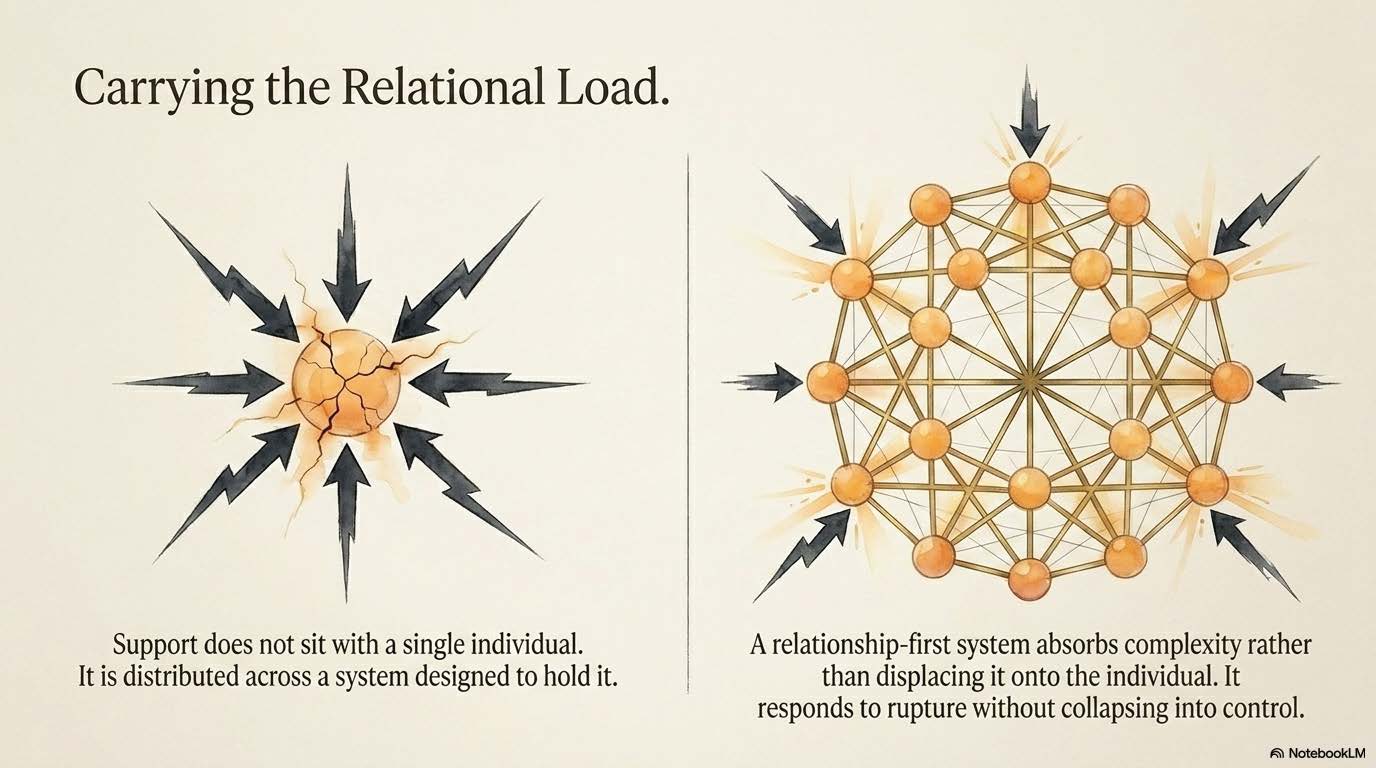
Support does not sit with a single individual, but within the structure itself. Relationship is not dependent on one connection, but distributed across a system that is designed to hold it.
This is what it means for a system to carry relational load.
To absorb complexity rather than displace it.
To respond to rupture without collapsing into control.
This is not theoretical.
It can be built.
It is being built.
The LoveKartelLaboratory is one such attempt. A space where the principles of relationship-first design are tested in practice. Where traditional hierarchies are flattened, where value is not determined by role, where support is not an afterthought but a structural condition.

It is not perfect.
It is an experiment.
But it is an experiment grounded in a simple proposition: If you change the relationship between order and relationship, you change the system.

theKNOWLEDGEPolitic exists to carry this further.
Not as a single organisation, but as a way of seeing.
A way of analysing systems not just by what they do, but by how they structure relationship. A way of identifying where order has overtaken connection. A way of imagining alternatives that do not abandon structure, but re-align it.
It is both a critique and a construction.
A refusal to accept that the current arrangement is inevitable.
And an invitation to participate in something different.

Because this is not just about systems.
It is about us.
Each person carries multiple versions of themselves. The part that adapted. The part that fractured. The part that is trying to integrate. And the part that is reaching toward others in a way that is not defined solely by survival.
A system can either force those parts further apart, or allow them to come together.
When relationship is held well, integration becomes possible.
Not perfectly. Not completely. But enough.
Enough to reduce the need for constant adaptation. Enough to allow intrinsic motivation to re-emerge. Enough to move from surviving the system to participating in it.
And eventually, to shaping it.
So this is not a set of instructions.

It is an invitation.
To notice where order has overtaken relationship.
To question what you have been asked to carry.
To hold more than one explanation at once.
To resist the pressure to resolve complexity too quickly.
To recognise that systems are not fixed — they are continuously reproduced through the relationships within them.
And to begin, wherever you are, to shift the balance.
Even slightly.
Because every system, no matter how large, is still only this: Relationship, given order, over time.
And if that is true, then it can be remade.
Not all at once.
But together.